Thursday, April 30, 2015

Friday, February 6, 2015
What is the internet?
Lately, the FCC has given the internet a lot of attention. Two topics have been voted on, one considering Net Neutrality and the other changing the official definition of broadband.
First off, Net Neutrality, to summarize what is it for those who do not know, can simply look at the video above provided by TechQuickie. This topic may not be important to most, to the people like me, who do, we are very passionate about topics such as this. The concept of slower access to content because of the content providers not paying enough money to ISP's to use internet fast lanes is enough to start arguments. The ruling for Net Neutrality is February 26, later this month.
Also, the FCC had voted to change the definition of broadband. Until recently, most US homes has access to broadband internet. The term broadband internet had the minimum speed of 4mbps/1mbps, that was until January 29. The two GOP members of the commission voted against the change, while the three Democrats, including FCC Chairman Tom Wheeler, approved it. The new official definition for broadband is now 25mbps/4mbps. That is a big jump, considering most smaller towns or cities do not provide this speed to homes. According to the new definition, 20% of homes will not be able to access broadband internet, an enormous leap from the original 6.3%. It may be a sign for improved internet speeds for cheaper prices, it may also mean it will cost more for certain speeds.
Also, the FCC had voted to change the definition of broadband. Until recently, most US homes has access to broadband internet. The term broadband internet had the minimum speed of 4mbps/1mbps, that was until January 29. The two GOP members of the commission voted against the change, while the three Democrats, including FCC Chairman Tom Wheeler, approved it. The new official definition for broadband is now 25mbps/4mbps. That is a big jump, considering most smaller towns or cities do not provide this speed to homes. According to the new definition, 20% of homes will not be able to access broadband internet, an enormous leap from the original 6.3%. It may be a sign for improved internet speeds for cheaper prices, it may also mean it will cost more for certain speeds.
Friday, January 30, 2015
Space X, a new step in space age technology?
A new space rocket was recently announced by Space X, Falcon Heavy. With 3.969 million pounds of thrust at liftoff and 4.5 million pounds in space, it will be the world's fastest rocket which equals roughly to the power of 15 Boeing 747 at full thrust. Set to launch later this year, it will be another special design by Space X.
 |
| Source: Space X |
Friday, January 23, 2015
Want to walk on mars in the comfort in of your living room? Now you can.

Being able to interact with digital objects was science fiction, holograms were only in science fiction movies is now a possibility. There are many existent footage of the product, real or not, they had done a live demo of the holo creator that allowed them to create a 3D object live. We may not get hover boards or flying cars with in the next year, but the HoloLens should be coming out in the time frame of Windows 10 which is set before the end of 2015.
Friday, January 9, 2015
All the new tech and ideas for the new year
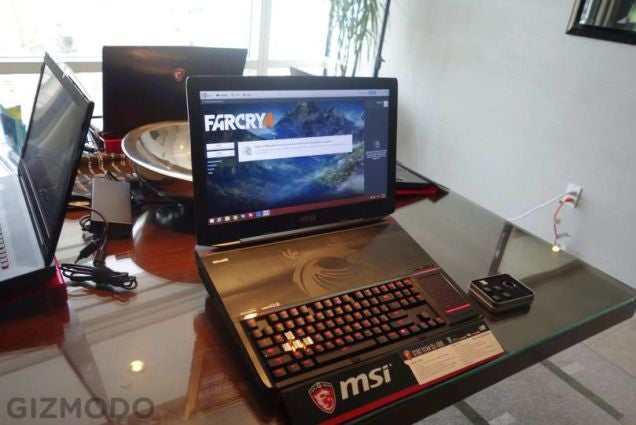
Following the trends of smart cars the past 2 years, BMW has announced their brand new car, the BMW I3; a unique smart car with the feature to come to you.Reminding anyone of any car featured in a movie? That's right, the BMW 750iL from James Bond- Tomorrow Never Dies. In the video to the right, Chris Ziegler with the Verge, had a test drive of the vehicle here.
Technology, advancing at in incredible rate, and CES is a way for companies such as these to give a taste of what is to come in the following year. Cars practically driving themselves. to being powered by oxygen and hydrogen to only leave water as waste. This is the seemingly future which we see ahead of us.
Technology, advancing at in incredible rate, and CES is a way for companies such as these to give a taste of what is to come in the following year. Cars practically driving themselves. to being powered by oxygen and hydrogen to only leave water as waste. This is the seemingly future which we see ahead of us.
Friday, December 12, 2014
Is a new form of renewable energy going to be underwater waves?
The United Kingdom; known for it's unique weather and the Queen,

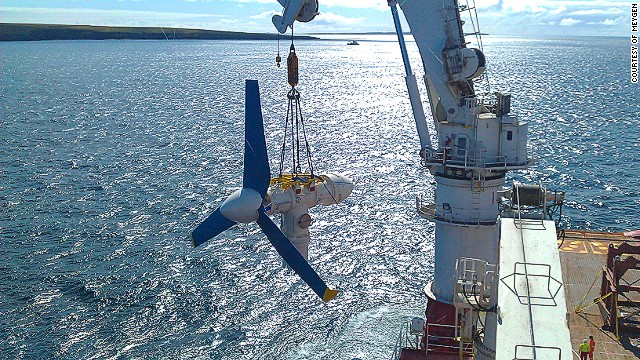
may not be able to create large amounts of renewable energy from the sun or from a wind farm, but there may be a new for of renewable energy. However, being a collection of islands, it does have thousands of miles of coastline which contains tides going up to 18 mph. An upside to using water instead of air, with the increased density compared that of air, it requires less surface area to create a spin with the blade, it will require less space per wheel. Another useful benefit is the turbines are underwater, and would not block the beautiful view outside into the ocean.
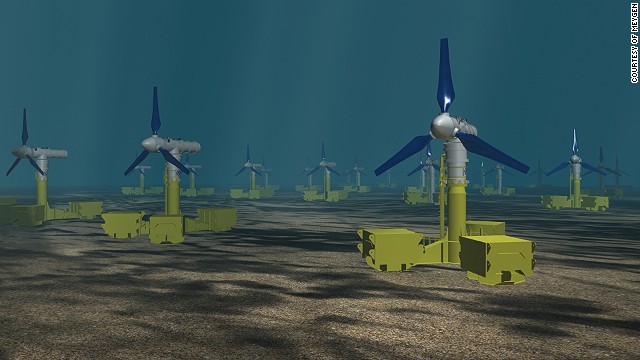 |
| Illustration of the Turbines underwater. Source: CNN |
Friday, December 5, 2014
NASA making history once again
Earlier this morning, at 7:05 a.m. PST, at the Space Launch Complex 37 at Cape Canaveral Air Force Station in Florida, Orion was launched into space. The project costed NASA $350 million this week alone. Upon reentry to Earth's atmosphere, the capsule was going at an incredible rate of 20,000 mph while experiencing temperatures over 2204º Celsius (4,000º Fahrenheit).
The test flight took 4 hours and 24 mins stated NASA. The capsule had landed off the coast of Baja California in the Pacific Ocean at 10:29 a.m. EST. Reaching heights over 3,604.2 miles, 15 times the height of the International Space Station at 268 miles in orbit. During it's flight, it had encircled the Earth twice
.
The test flight took 4 hours and 24 mins stated NASA. The capsule had landed off the coast of Baja California in the Pacific Ocean at 10:29 a.m. EST. Reaching heights over 3,604.2 miles, 15 times the height of the International Space Station at 268 miles in orbit. During it's flight, it had encircled the Earth twice
.
Friday, November 14, 2014
Typing with your mind
 |
| The BCI home system Source: http://www.wadsworth.org/ |
Friday, November 7, 2014
Are we closer to Back to the Future?
 |
| Source: Back to the Future |
 |
| Source: inventist.com |
Friday, October 10, 2014
Water that is out of this world.
 |
| Artist's rendition by David A. Aguilar, CFA |
Friday, October 3, 2014
Deadly force against rocks

The US is stockpiling nuclear weapons to prevent asteroids from hitting the Earth when the time comes. Spending time envisioning such an event, the United Nations and NASA has an increasing favor towards nuclear weapons. Stockpiling nuclear warheads, bombs, and more might seem useless to citizens, but not in the eyes of the UN. As stated in Wired.co.uk, Former NASA astronaut Ed Lu remarked that there are "100 times more asteroids lurking in space than have ever been located," and that our challenge is "to find them before they find us". A device called Sentinel Space Telescope (SST) is being created by the B612 Foundation, co-founded by Lu. A SST is a privately built infrared device allows the UN to accurately track asteroids on route to hit the Earth years ahead of time. The time estimated for the project to finish is told to be 2017.

Friday, September 26, 2014
Obama creates large marine reserve
 |
| MAGGIE SMITH, NG STAFF. SOURCES: U.S. FISH AND WILDLIFE SERVICE; USGS; MARINE CONSERVATION INSTITUTE |
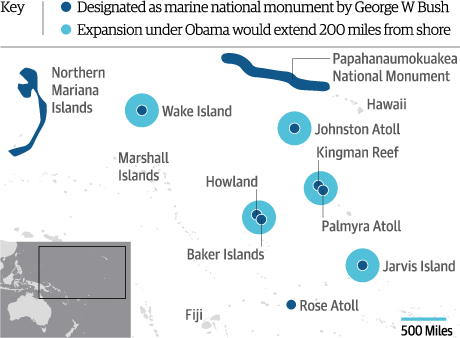 |
| Pacific Ocean reserve Photograph: Guim |
Announced
last Thursday, by existing monument around U.S. controlled islands, it will be
the largest marine reserve ever. Acting quickly, for the 12th time
Obama has bypassed Congress and used the Antiquities Act for environmental
protection. It will expand the reserve while some parts are untouched. Three
times the size of California, 6 times it's original, at 490,000 square miles.
Even with the enormous amount of expansion, it is nowhere near the size
of 754,400 square miles that President Obama was hoping for. This will
take effect in January of 2015. Protecting waters near a tiny island state of
Kiribati, one of the last great tuna grounds left in the world.
Thursday, September 18, 2014
How fast can humans run?
 |
| Source: NASA |
After 40 years in the
dark, this question was finally answered. Experiments to see how fast a human
can run on the moon has taken place. Taking place on NASA's DC-9 aircraft. An
aircraft capable of reducing its internal gravity to the match the moon's while
in the swooping motion. There were eight participants, three being astronauts.
Each astronaut was asked to run for 20 seconds long in the artificial lunar
gravity.
 |
| Source: NASA |
The theoretical average
calculated by NASA was 1.8 miles per hour (2.89 km), was a dramatic difference
to the average on Earth being 4.5 miles per hour (7.24 km). After the
experiments, the results was an average of 3 miles per hour (5 km), a much
closer calculation. The theory revolving around why their theoretical
calculation is the boost created by the counter-swinging motion of the
participants' arms and legs.
Thursday, September 4, 2014
How 3D printing can change our lives.
 |
| Source: The Verge |
 |
| Source: Space.com |
The
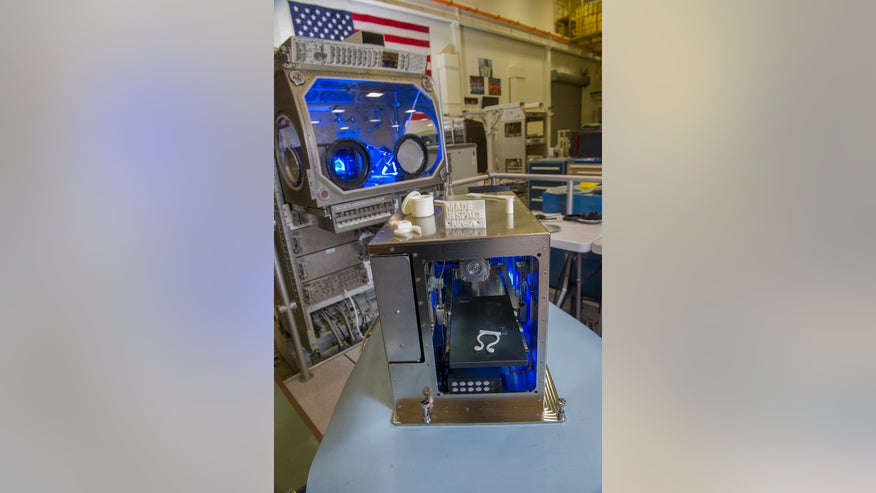
first 3D printed object was created in 1984 by Charles W. Hull. From the
cost of $20,000 for a printer to only $1,000 in the course from 2010 to 2013
alone. Now this technology no less than 2 years has been growing in popularity
and the uses of it. As in my last blog, NASA has made a rocket injector (fuel
injector) using 3D printing. As more attention is attracted to this technology,
more of the bigger companies are buying printers and coming up with cheaper and
easier ways to innovate. As it began growing in popularity, their uses were
only for creating small objects such as cups or decorations. Since then, now
their uses range far and wide, ranging from a mere simple printed name to a
working bicycle to a working weapon. Caused by the uses and possibilities this
provides, are many risks and many dangers. The reliability and efficiency it
provides even NASA has uses for it. Instead of sending a space ship to give simple tools to the space station, a new one can be printed on the station. As NASA plans to send 3D printers in space
for use, a Boston hospital recently 3D printed a toddler's brain before his
actual hemispherectomy to insure success. Hemispherectomy is one of the rarest
and most challenging surgery which half of the brain is removed or disabled.
The versatility is said to boost economies and help smaller businesses.
Friday, August 29, 2014
NASA creates sparks with 3D printing to push the limits
 |
| Image Credit: NASA photo/David Olive |
NASA joins the 3D printing trend with a rocket part which survived a 6,000 degree test-firing. The test took place in NASA's Marshall Space Flight Center in Huntsville, Alabama on August 28th. The idea of using 3D printing is to lower costs and raise efficiency without any compromises.
The rocket injector (fuel injectors) was made based on the process known as selective laser melting. Selective laser melting is printing each part by layering metal powder and fusing it together with a laser. This allows less errors to be made with improved performance and less prone to failures. With 3D printing, tests and improvements can be made faster and easier than ever.
The printed rocket injector was similar in size to a exploration class injector. During the two tests each 5 seconds long, two rockets injectors. Creating 20,000 pounds of pressure with 1,400 pounds per square inch and producing up to 6,000 degrees Fahrenheit.
Subscribe to:
Posts (Atom)