Friday, January 9, 2015

All the new tech and ideas for the new year

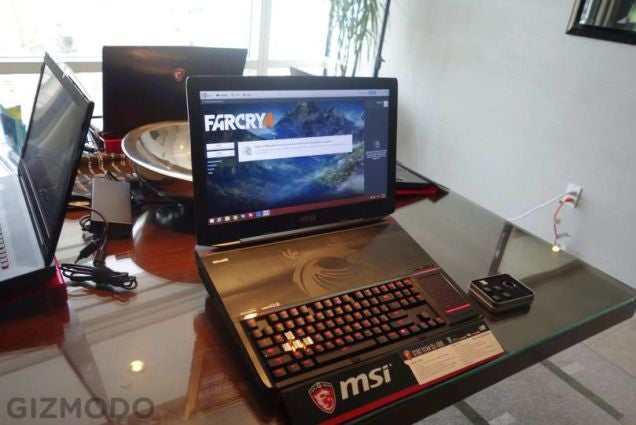
                CES (Consumer Electronics Show), an event held once a year to introduce the ideas of independent inventors and big companies in general. From a new generation of ars to laptops; this event holds most of the companies grand products. Numerous companies rush in order create such a product such that no one could forget  until it is in stores. In example; MSI has created a laptop that is sure to boost the increase in laptop performance. Recently at CES announced their laptop powerful enough to replace a full sized desktop.
                Following the trends of smart cars the past 2 years, BMW has announced their brand new car, the BMW I3; a unique smart car with the feature to come to you.Reminding anyone of any car featured in a movie? That's right, the BMW 750iL from James Bond- Tomorrow Never Dies. In the video to the right, Chris Ziegler with the Verge, had a test drive of the vehicle here.
                Technology, advancing at in incredible rate, and CES is a way for companies such as these to give a taste of what is to come in the following year. Cars practically driving themselves. to being powered by oxygen and hydrogen to only leave water as waste. This is the seemingly future which we see ahead of us.

Friday, December 12, 2014

Is a new form of renewable energy going to be underwater waves?

The United Kingdom; known for it's unique weather and the Queen,
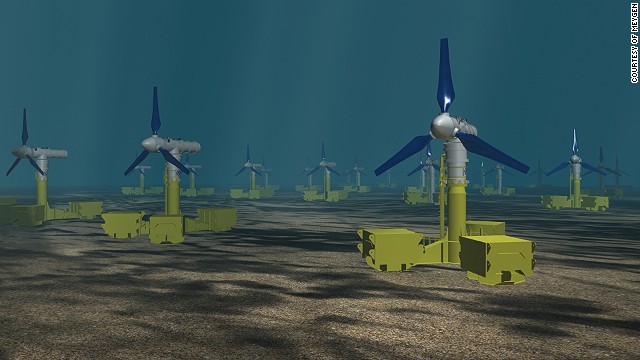
Illustration of  the Turbines underwater.
Source: CNN
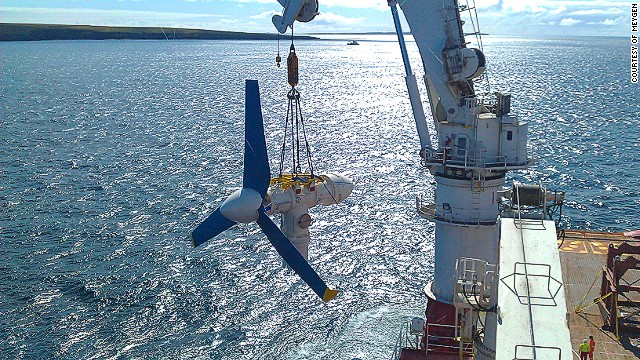
may not be able to create large amounts of renewable energy from the sun or from a wind farm, but there may be a new for of renewable energy. However, being a collection of islands, it does have thousands of miles of coastline which contains tides going up to 18 mph. An upside to using water instead of air, with the increased density compared that of air, it requires less surface area to create a spin with the blade, it will require less space per wheel. Another useful benefit is the turbines are underwater, and would not block the beautiful view outside into the ocean. 

Friday, December 5, 2014

NASA making history once again

Earlier this morning, at 7:05 a.m. PST, at the Space Launch Complex 37 at Cape Canaveral Air Force Station in Florida, Orion was launched into space. The project costed NASA $350 million this week alone. Upon reentry to Earth's atmosphere, the capsule was going at an incredible rate of 20,000 mph while experiencing temperatures over 2204º Celsius (4,000º Fahrenheit).
The test flight took 4 hours and 24 mins stated NASA. The capsule had landed off the coast of Baja California in the Pacific Ocean at 10:29 a.m. EST. Reaching heights over 3,604.2 miles, 15 times the height of the International Space Station at 268 miles in orbit. During it's flight, it had encircled the Earth twice
.

Friday, November 14, 2014

Typing with your mind

                Ever wondered if we will be able to one day type without physically touching the keyboard? That is becoming a possibility due to the Brain- Computer Interface (BCI) created by Wadsworth Center in Albany, NY.


The BCI home system Source: http://www.wadsworth.org/
                The way it works is with a machine which takes readings of patterns when certain letters flashes, verifying the target letter. For now, it is extremely expensive and uses very complex programming. In hopes of this becoming a affordable way for anyone with disabilities limiting their abilities to type. While typing is a major point in this program, it is only a speck of the possibilities such programs can provide.

Friday, November 7, 2014

Are we closer to Back to the Future?

Source: Back to the Future
Source: inventist.com
Electric skateboards and magnetic skateboards with no wheels are becoming more common as 2015 is coming closer. In the 1985 movie, "Back to the Future" Marty McFly used a hover board. The truth is, we might not have that technology any time soon, so we have to make due with what we have now, motorized personal transportation. They are simple concepts, attaching motorized wheels anything transportation. Ranging from different sizes of small to large, from the size of a baseball to the size of a long board. They are often very versatile and fairly affordable. Many independent companies like Inventist have started to take on the challenge of creating a easy, safe, and effective way to commute to work, to the movies, to the park, or simply go down the street to a friend's house. They made a very compact and easy to control way of transportation such as their Orbit Wheel.

Friday, October 10, 2014

Water that is out of this world.

illustration of the Neptune-size HAT-P-11b
Artist's rendition by David A. Aguilar, CFA
A planet found in 2009 known as HAT-P-11b proven to host water recently. Found by Jonathan Fraine and his colleagues, its diameter is barely larger than 4 times the Earth's. Until recently, Neptune had been the only exoplanet to contain water. The temperature of the planet is roughly from 828° Kelvin to 928° Kelvin (1031° Fahrenheit to 1211° Fahrenheit). Its atmosphere's composition is primary hydrogen, hypothesized to have been drawn from nearby infant stars. Made primary of hydrogen the planet is found to have trace amounts of unidentified heavier elements. The atmosphere absorbs certain colors of light and filtering star light.

Friday, October 3, 2014

Deadly force against rocks


The US is stockpiling nuclear weapons to prevent asteroids from hitting the Earth when the time comes. Spending time envisioning such an event, the United Nations and NASA has an increasing favor towards nuclear  weapons. Stockpiling nuclear warheads, bombs, and more might seem useless to citizens, but not in the eyes of the UN. As stated in Wired.co.uk, Former NASA astronaut Ed Lu remarked that there are "100 times more asteroids lurking in space than have ever been located," and that our challenge is "to find them before they find us". A device called Sentinel Space Telescope (SST) is being created by the B612 Foundation, co-founded by Lu. A SST is a privately built infrared device allows the UN to accurately track asteroids on route to hit the Earth years ahead of time. The time estimated for the project to finish is told to be 2017.